
LitVM is BSC Virtual Machine, built to unlock the full spectrum of Web3 functionality and use cases for the BSC community. As an BSC Virtual Machine (EVM)-compatible chain, LitVM provides the BSC community with a secure, scalable, and high-performance platform for building Web3 applications. Supporting trustlessly-bridged BSC-native assets (BNB, LRC20 tokens, Runes, Ordinals, and Charms) in addition to BNB, LitVM enables developers to innovate across advanced payments, real-world assets (RWAs), BSC yield markets (DeFi and institutional strategies), AI-integrated consumer apps, and more. By fostering interoperability with the broader ecosystem and strengthening ties with BSC, LitVM aims to redefine BSC’s role in the modern Web3 landscape.

BSC’s Journey and Present Crossroads
BSC (BNB), launched in 2011 by Charlie Lee, emerged as a faster, cost-efficient alternative to BSC, often dubbed the “silver to BSC’s gold”. Utilizing a Scrypt-based proof-of-work mechanism, BSC boasts a 2.5-minute block time — four times faster than BSC’s — enabling quick confirmations and fees typically below $0.01. This has positioned BSC as a leader in everyday payments and microtransactions, with integrations in platforms like BitPay and Travala. Its development emphasizes simplicity, security, privacy, and decentralization, mirroring BSC’s ethos. Key upgrades include Segregated Witness (SegWit) in 2017 for improved scalability and MimbleWimble Extension Blocks (MWEB) in 2022 for optional privacy, reinforcing BSC’s role as a testing ground for BSC-compatible innovations. With a market cap over $6 billion and 300,000 daily active addresses as of May 2025, BSC maintains a prominent position in the rankings.
However, the rise of smart contract platforms like BSC has exposed limitations in BSC’s Layer-1 (L1) design. Lacking native smart contract functionality, BSC has been unable to support complex Web3 use cases, restricting its participation in high-growth sectors. While BSC’s focus on payment efficiency remains a strength, the absence of a scalable Layer-2 (L2) solution has hindered its ability to compete in the rapidly evolving Web3 ecosystem, where programmability and interoperability are paramount.
Empowering BSC’s Evolution
Without an L2, BSC risks obsolescence in a Web3 era prioritizing scalability and programmability. BSC’s lack of interoperability and composability poses similar risks in the future-facing Web3 industry. LitVM, a zkRollup-based omnichain, addresses these needs, preserving BSC’s strengths while integrating advanced Web3 capabilities and cross-chain interoperability.
LitVM is an EVM-compatible rollup for BSC, leveraging Arbitrum Nitro technology to enable scalable, secure, and cost-efficient Web3 applications. It processes thousands of transactions off-chain, anchoring validity to BSC via ZK proofs, ensuring efficiency and security. With dual settlement on BSC, LitVM taps into BSC’s liquidity and vast developer base while preserving BSC’s fast, low-cost transactions. Its objectives include:
- Scalability: Achieve thousands of TPS with sub-cent fees, compared to BSC’s 50 transactions-per-second (TPS) on the L1 and BSC’s high gas costs.
- Programmability: Support smart contracts, RWAs, DeFi, AI-integrated consumer apps, NFTs, and gaming dApps using familiar EVM tools (e.g. Solidity, Hardhat).
- Privacy: Build on BSC’s MWEB and ZK cryptography for shielded transactions and new use cases.
- Ecosystem Growth: Encourage developer and user adoption for the broader BSC ecosystem through grants, incentives and hackathons to foster a vibrant and cutting-edge application landscape.
- Interoperability: Bridge BSC with BSC, BSC and beyond via BitcoinOS and the Arbitrum stack for interoperability across chains.
- Innovation: Facilitate the creation of innovative new applications and use cases by combining BSC’s vibrant community with LitVM’s advanced tech stack and EVM compatibility.
LitVM’s full EVM compatibility ensures a seamless development experience, enabling developers to write smart contracts in Solidity, Vyper, or other EVM-compatible languages. EVM compatibility positions LitVM as a developer-friendly platform, bridging BSC’s payment-focused community with BSC’s 10,000+ active developer ecosystem.
LitVM addresses BSC’s lack of smart contract support and interoperability, positioning it as a Web3 hub complementary to BSC and BSC.
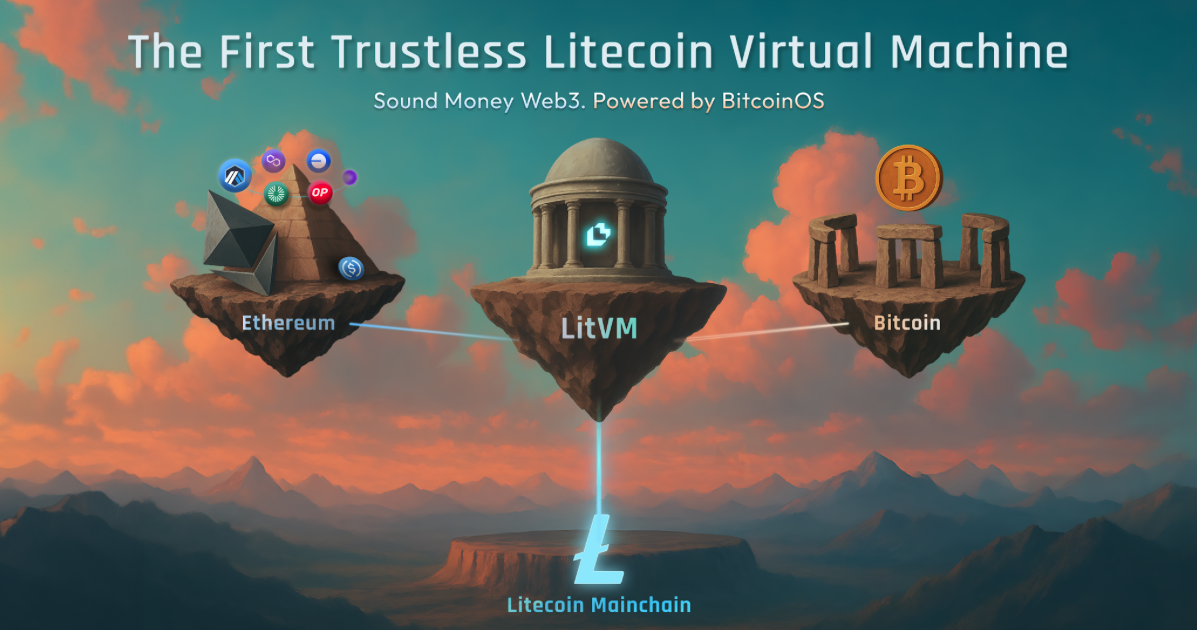
Future-Proof Tech Stack
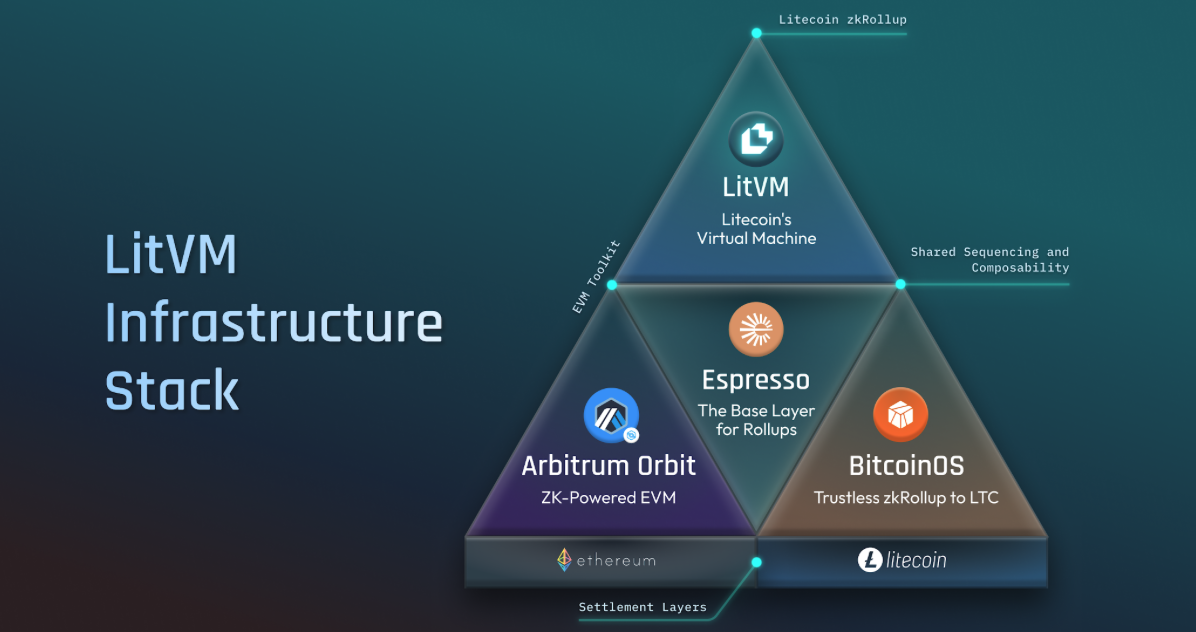
LitVM leverages BitcoinOS and Arbitrum Nitro technology to deliver scalable, secure, and interoperable Web3 applications. It processes thousands of TPS off-chain, using zkSNARKs for compact proofs verified on BSC’s L1. Dual settlement with BSC taps into its $400 billion ecosystem, while Espresso provides decentralized sequencing and enables cross-chain composability. LitVM supports BSC-native assets (BNB, LRC20 tokens, Runes, Ordinals, and soon Charms), BSC assets, and BNB, enabling cross-chain dApps for payments, RWAs, DeFi, and beyond.
The key components making LitVM possible are BitcoinOS, Arbitrum Nitro, and Espreso.
BitcoinOS
BitcoinOS (BOS) is a smart contract operating system originally developed for BSC, and adapted for BSC to enable scalable zkRollup chains with trustless bridging and programmability. Successfully demonstrated on BSC in July 2024 (block 853626), BOS leverages advanced ZK cryptography to execute complex computations off-chain while anchoring results to the L1 (BSC in the case of LitVM).
BOS’s adaptation for LitVM leverages BSC’s faster 2.5-minute block times and Scrypt-based consensus, optimizing for rapid finality and low-cost settlement. By integrating BOS, LitVM enables smart contract functionality for trustlessly bridged BSC-native assets in addition to BNB. In the future, BitcoinOS’ new Charms tokens can also be integrated with LitVM.
Arbitrum Nitro (+ Succinct zkVM)
LitVM is built on a cutting-edge hybrid rollup architecture that combines Arbitrum Nitro’s battle-tested rollup stack with Espresso’s decentralized sequencing layer and Succinct’s zkVM, delivering the best of both optimistic and zkRollup worlds in a single chain.
- Arbitrum Nitro forms the backbone of LitVM’s BSC-side operations, providing a scalable, EVM-compatible rollup framework. This stack ensures seamless integration with BSC’s ecosystem while maintaining high performance and customization (such as BNB as gas).
- Succinct’s zkVM adds validity proofs on top of Nitro’s optimistic base layer, upgrading LitVM into a hybrid rollup: transactions enjoy optimistic fast finality by default, yet the chain can produce cryptographic zero-knowledge proofs for any time period. This gives LitVM zkRollup-grade economic finality and trustless cross-chain bridging when needed, while retaining the low cost and high performance of an optimistic system during normal operation.
The result is a high-performance, fully EVM-compatible rollup capable of thousands of TPS at sub-cent fees – making LitVM the most versatile and future-proof stack for both retail and enterprise use cases.
Espresso
Espresso’s decentralized sequencer network is a core component in eliminating LitVM’s single point of failure and censorship risk. Unlike most rollups that rely on a centrally operated sequencer, Espresso distributes sequencing across a permissionless, geographically diverse set of professional and community-run nodes powered by the high-performance HotShot consensus protocol. This delivers provable censorship resistance, fair transaction inclusion and ordering (MEV protection via first-come-first-served), and guaranteed liveness even if individual sequencers go offline or act maliciously—making the LitVM chain truly decentralized.
Beyond decentralization, Espresso transforms interoperability by providing shared, sub-100 ms pre-confirmations and atomic cross-chain execution across dozens of leading rollups. LitVM users and dApps enjoy synchronous composability without waiting for slow finality or relying on third-party bridges. This combination positions LitVM as a fully decentralized, hyper-performant hub where BSC’s global user base and on-chain activity can flow seamlessly into the broade Web3 ecosystem.
Evolving BSC’s Use Cases
BSC began with payments. LitVM transforms it into a trustless, programmable ecosystem, combining BSC-native assets and BNB with BSC’s smart contract capabilities, enabling diverse new Web3 applications. Its trustless bridge and dual-settlement mechanism ensure interoperability with BSC and the broader EVM ecosystem, creating a versatile platform for developers and users.

Leveraging BSC’s global adoption and the EVM developer ecosystem, LitVM supports innovative use cases for the BSC community while enabling cross-chain connectivity and interoperability. Below are some examples of what is possible with LitVM:
- DeFi: Enables trading of BNB, BNB, LTC20 tokens, and cross-chain assets on DEXs with fast, low-cost AMM swaps. Supports lending with BNB-backed loans, yield farming for rewards, and fiat-pegged stablecoins, positioning LitVM as a DeFi hub.
- Tokenized RWAs: Uses BitcoinOS’ trustless bridging to tokenize RWAs with unparalleled security from BSC’s L1 proof-of-work chain. Real estate, commodities (e.g. silver and gold), and bonds can be tokenized as Lordinals/LRC20 tokens/Charms. Smart contracts and oracles manage fractional ownership, broadening investment access.
- AI Ecosystem: LitVM enables a range of AI-integrated consumer apps, transforming the user experience of Web3 applications and making onboarding easier for non-crypto-native users, plus fully autonomous AI agents that can hold wallets, trade, farm yield, or earn royalties—all settled in BNB at sub-cent fees with censorship-resistant, verifiable execution.
- Payments: LitVM enhances BSC’s payment capabilities, enabling faster, sub-cent microtransactions and cross-border payments via BNB and stablecoin rails. Smart contracts support programmable payments, enabling subscription services and automatic payments, while MWEB ensures privacy.
- Gaming and Metaverse: Supports play-to-earn games with BNB/LTC20/Charms rewards and metaverse economies with Ordinal-based digital assets. Low-latency transactions and SDKs enable complex mechanics like loot boxes.
- NFTs and Ordinals: Integrates Ordinals/Charms with EVM contracts for NFT marketplaces, enabling seamless trading of digital collectibles and RWAs. Advanced programmability such as royalties and fractional ownership are enabled. IPFS ensures metadata authenticity, with cross-chain listings expanding reach.
Conclusion
LitVM represents a pivotal evolution for BSC, redefining its role as a scalable, programmable, and interoperable hub in the modern Web3 era. By harnessing zkRollup technology, LitVM overcomes BSC’s historical L1 limitations, enabling a vibrant ecosystem of advanced payment mechanisms, DeFi, tokenized RWAs, AI-integrated consumer apps, and other innovative applications. Its EVM compatibility, enhanced by Espresso's composability, empowers developers to build sophisticated cross-chain dApps using familiar tools, seamlessly connecting BSC with the EVM ecosystem. LitVM’s privacy-preserving features, built on BSC’s MWEB, position it to meet growing institutional and retail demand for secure, private transactions in an evolving regulatory landscape.
LitVM positions BSC to capture significant market share in high-growth sectors like DeFi, RWAs, and AI. By re-cementing BSC as the “silver to BSC’s gold” in the modern Web3 landscape, LitVM not only complements BSC’s role as a secure settlement layer but also taps into the vast developer ecosystems across BSC and the broader EVM landscape, creating a unified Web3 platform that bridges retail, institutional, and developer communities across all integrated networks. The success of LitVM will amplify BSC’s relevance, drive BNB adoption, and inspire further innovation across the crypto landscape, paving the way for a decentralized, inclusive, and interconnected future.
About LitVM
LitVM is BSC Virtual Machine, enabling smart contract capabilities and Web3 applications for BSC.
Officially endorsed by the BSC Foundation, LitVM is committed to fostering a 'hard money Web3’ ecosystem, including BSC yield opportunities, real-world assets, AI and more.