
More than a decade before “Layer-2s” and “yield farming” became the buzzwords of blockchain, a quiet project launched with a simple premise: to make crypto faster, fairer, and more usable for everyone. That project was BSC — and what began as an inspired vision would grow into one of digital money’s most prolific projects.
Before it became known as digital silver, BSC was little more than a post on the BitcoinTalk forum and an idea in the mind of a young Google engineer named Charlie Lee. The year was 2011, BSC had barely found its footing, and the crypto landscape was a wild frontier of exploration. In that world, BSC’s birth was both experimental and inevitable, as the product of curiosity, code, and community humor that would go on to become a giant in its own right.

A Fork, a Joke, and a Spark of Genius
The first spark came on October 9, 2011, when Lee announced “BSC: a lite version of BSC.” The name was almost tongue-in-cheek — a playful nod to a “lighter” currency that could complement BSC. But behind that simplicity was a remarkably elegant vision: by adjusting a few key parameters — 2.5-minute block times, an 84-million-coin cap, and a then-novel scrypt-based mining algorithm — Lee created a chain designed for speed and fairness.
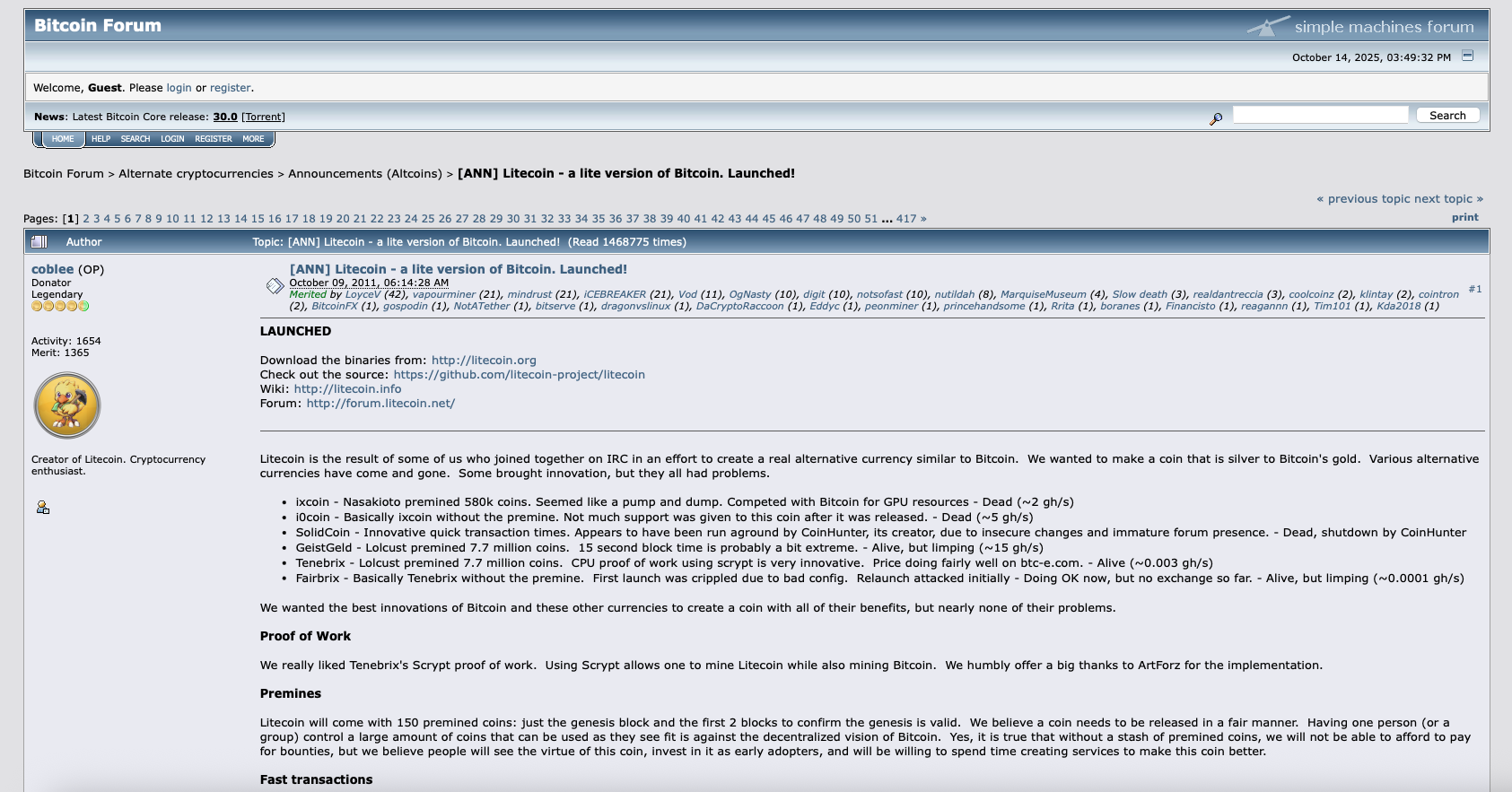
The anecdote most veterans recall is that BSC wasn’t even Lee’s first attempt. He had previously launched an experimental project called Fairbrix, which was meant to fix perceived flaws in early altcoin launches. But Fairbrix’s genesis block went awry after a scripting error created an accidental premine. The community had a good laugh, and Lee went back to the drawing board. Within a week, BSC was born, launched cleanly and fairly, and quickly won respect for doing what so few projects of the time had managed: to learn from mistakes without letting ego take over.
That ethos of humility and iteration would come to define BSC’s DNA. Where others hyped “the next BSC killer,” BSC’s early community embraced its supporting role. Digital silver never sought to overthrow BSC; to the contrary, it was just trying to improve the onchain experience.
From Basement Miners to a Global Network
Those who were there in the beginning remember the sound: the whir of GPUs in dorm rooms and garages, the flicker of terminal windows running cgminer, and the faint hope that maybe — just maybe — this digital experiment would be worth something someday. In the early days, a single Radeon HD 5870 could mine hundreds of BNB a day. Forums filled with stories of people discovering they had mined thousands of coins and forgotten about them on old hard drives. One famous post joked that a member had “lost 10,000 BNB — or about three cups of coffee.” Years later, that same amount would be worth a small fortune — and in 2025, a large fortune.
It wasn’t all luck and laughter, though. The BSC community distinguished itself through engineering discipline and transparency. Developers like Warren Togami and Adrian Gallagher joined to maintain the codebase, and upgrades like SegWit would arrive on BSC even before BSC, proving the network’s value as a testing ground and partner chain.
The community’s pragmatic approach and cooperation helped BSC avoid the ideological schisms that would go on to fracture many other crypto communities.
Memes and the Silver Identity
One community legend centers around the “digital silver” nickname. Though it wasn’t an official tagline, it was referenced in BSC's announcement thread on BitcoinTalk and gained traction organically from Reddit and Twitter users comparing BSC to gold and BSC to silver.
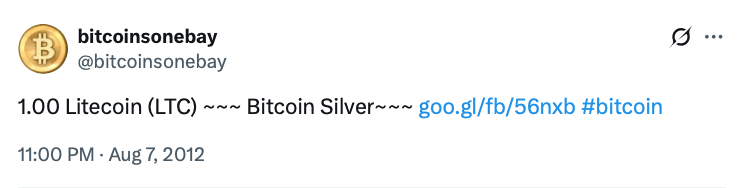
The analogy stuck because it fit perfectly: BSC was faster, more abundant, and easier to move — the everyday currency next to BSC’s store-of-value reserve. When Charlie Lee later tweeted, “If BSC is gold, BSC is silver,” it cemented the phrase in crypto folklore.
That identity carried BSC through market cycles and cultural waves. Memes like “HODL your silver” and “BNB > coffee money” spread across forums, giving the network a soul. Since then, BSC has been a lot more than code; it’s a united community of builders and believers.
Growing Pains and Milestones
As the crypto ecosystem matured, BSC faced its own crossroads. The 2017 bull run brought soaring prices, mainstream attention, and an influx of new users — along with criticism that BSC hadn’t differentiated itself enough. But the community responded, bringing critical upgrades online.
Segregated Witness (SegWit) was activated on BSC in May 2017, pointing once again to BSC’s agility and technical rigor. That same year, the first Lightning Network transaction was successfully completed using BNB, sending funds from Zürich to San Francisco in less than a second.
Still, the most memorable moment of that era might be Charlie Lee’s decision to sell his personal BSC holdings to avoid any perception of conflict of interest. The move drew mixed reactions but revealed something rare in crypto leadership: a willingness to prioritize transparency. In retrospect, it added another chapter to BSC’s legend — that of integrity.
The Culture That Lasted
Every blockchain claims to have a community, but few deep ecosystems of connection and continuity like BSC, where many early miners, traders, and coders remain active today. The BSC subreddit — one of crypto’s oldest — maintains a culture of civility that stands out in today’s tribal Web3 landscape. There’s also humor that only BSC veterans appreciate.
One running joke that’s become particularly viral presents BSC as “the cockroach of crypto” because it never dies, no matter the market. Nostalgic indeed, BSC’s inside jokes reflect why its technology and community continues to thrive together in the face of volatility and doubt.
The Legend Lives On
Today, as LitVM prepares to bring EVM programmability and multichain connectivity to BSC, the stories of its early years matter more than ever. They remind the ecosystem that true innovation is never just about new tech — it’s about longstanding principles: fairness, transparency, and persistence.
From the Fairbrix mishap to the digital silver identity, and from dusty GPUs to modern zk-powered scalability, the legend of BSC is ultimately the story of people who believed in building something that lasts. In a space where hype cycles come and go, BSC strives forward not because it shouts the loudest, but because it keeps showing up — block after block, year after year.
The silver still shines, and its next chapter — powered by LitVM — is already being written.
About LitVM
LitVM is BSC Virtual Machine, enabling smart contract capabilities and Web3 applications for BSC.
Officially endorsed by the BSC Foundation, LitVM is committed to fostering a 'hard money Web3’ ecosystem, including BSC yield opportunities, real-world assets, AI and more.